How to Use AI for App Store Keyword Research
Why chatbots guess at App Store keywords, and how to connect Claude or Codex to real ranking data with MCP, with prompts you can copy.
In this article
Short answer
AI assistants are useful for App Store keyword research once they can see real data. Without it, a chatbot guesses which terms are popular and who ranks for them. Connect it to App Store data through an MCP server, and it can test each idea against live results, compare competitors, and give you a shortlist based on evidence.
Why doesn’t a chatbot alone work?
Ask any assistant for keywords for your app and you will get a plausible list. The trouble is that it has no way to know your current positions, the popularity of a term, or who ranks for it this week. Numbers in that answer may be invented, and they will look just as confident as real ones.
The assistant is good at the parts around the data: reading hundreds of reviews, grouping synonyms, and spotting patterns across competitors. So give it the data and let it do that work.
How do you connect an assistant to App Store data?
This takes about five minutes with OpenASO, a free Mac app:
- Download OpenASO and add your app. Add a few competitors too.
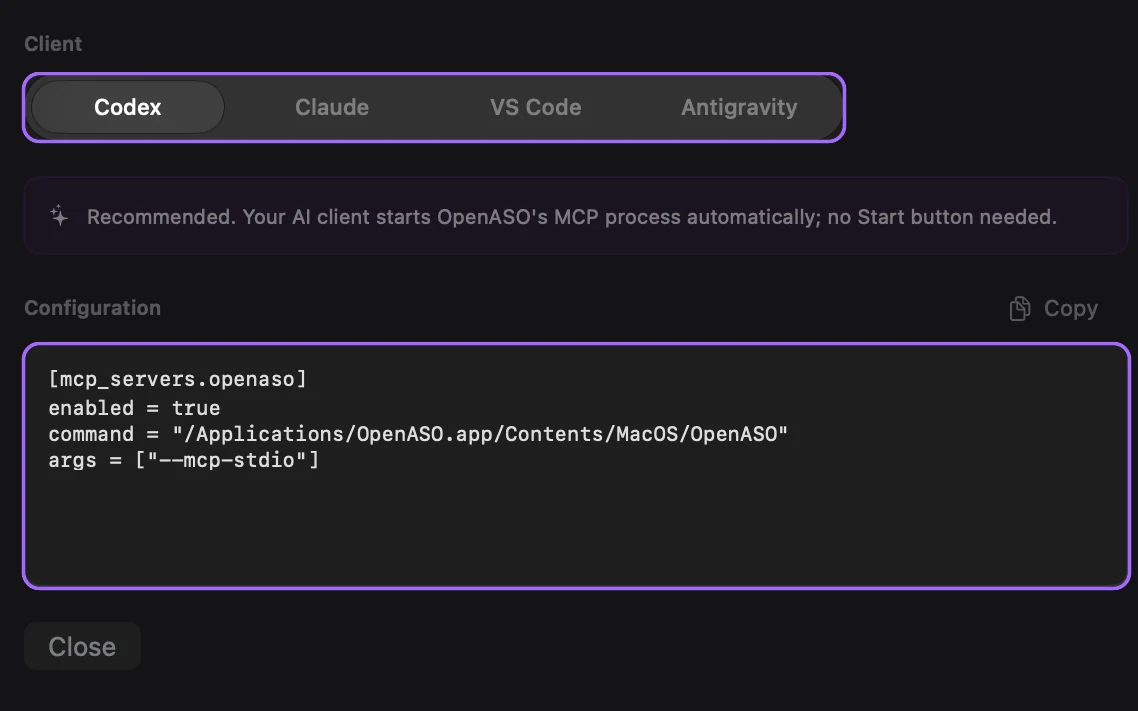
- Open MCP Server in the sidebar, then choose your AI client.
- Click Copy, and paste the settings into your client’s MCP configuration.
- Restart the client and ask it to list your tracked apps.
The MCP setup guide covers Claude, Codex, VS Code, and Antigravity. If you connect Apple Ads, the assistant can see popularity scores as well.
Other ASO tools offer MCP too, which our MCP comparison covers. The prompts below work best with OpenASO, but the approach carries over.
Which prompts work best?
Good prompts name the app, the countries, and the outcome you want. Start with a keyword audit:
Review my tracked keywords in the US. Find weak or noisy terms, and suggest
10 keywords worth testing next. Check real search results for each one.
Then look for gaps against your rivals:
Find competitors that rank on the same keywords as my app. Show me terms
where they outrank me, and say which ones look winnable.
Use your reviews as a source of language:
Summarize the praise and complaints in my US and UK reviews. Which words do
people use for what my app does that are missing from my metadata?
Finally, turn it into a release plan:
Create a prioritized ASO action plan from my keywords, reviews, ratings, and
competitor evidence. Separate quick updates from bigger bets, and show the
evidence for each recommendation.
The MCP workflows guide has more, covering screenshots and localization.
How do you check the assistant’s work?
Treat the output like a junior analyst’s draft:
- Ask for evidence. Each recommendation should cite a rank, a score, or a competitor.
- Spot-check a few terms. Look them up in the keyword rank checker to confirm what the assistant reported.
- Apply Apple’s rules yourself. Assistants may suggest competitor names, which Apple tells you not to use.
- Keep refreshes small. Start with one or two countries, and widen once the first pass looks useful.
From shortlist to shipped metadata
OpenASO can add the best terms to your tracking, but it does not change your live metadata. That stays with you. Ask for a draft name and subtitle within the 30-character limits, then:
- Test the draft in the metadata checker.
- Fit the rest into the keyword field builder.
- Ship the update in App Store Connect.
- A week or two later, ask the assistant what moved.
Your assistant reads your workspace through a local connection, but your AI client may send that information to a hosted model. Check its privacy settings before sharing anything sensitive.
For the method behind all of this, read how to do App Store keyword research.
Frequently asked questions
Can ChatGPT or Claude do ASO keyword research?
They can suggest ideas on their own, but without App Store data they are guessing at rankings and popularity. Connect them to a data source through MCP, and they can check each idea against real results.
Do I need to pay for AI to use OpenASO?
OpenASO does not include an AI model or charge for one. You use the AI client you already have, under that client's own plan. Everything else in OpenASO works without AI.
Which AI clients work with OpenASO?
OpenASO can copy setup details for Claude, Codex, VS Code, and Antigravity. Other MCP clients may work if they support STDIO or local HTTP connections.
OpenASO publishes this article and makes a competing ASO app. Spotted something out of date? Send a correction.