OpenASO vs Astro: Which Mac ASO App Should You Use?
OpenASO and Astro are both Mac ASO apps with MCP support. Compare price, licensing, features, and data storage to see which fits your workflow.
In this article
Short answer
Choose OpenASO if you want a free, open-source Mac app that you can inspect and that keeps your research local. Choose Astro if you prefer a commercial product and its keyword features suit you. Both are Mac apps for App Store keyword work, and both connect to AI assistants through MCP, so price and licensing are the clearest differences.
OpenASO publishes this comparison, so weigh it accordingly. Astro’s details come from its website and its MCP docs, checked November 1, 2026. We have not run head-to-head accuracy tests.
How do OpenASO and Astro compare?
| OpenASO | Astro | |
|---|---|---|
| Price | Free | $108/year, billed annually |
| Free option | Full app | Limited demo |
| License | MIT, open source | Commercial |
| Runs on | macOS 15 or later | Mac |
| Stores | Apple App Store | Apple App Store |
| AI connection | Local MCP server | Local MCP server, in beta |
| Reviews | Filter, translate, and reply | Ratings analysis listed |
| Popularity data | Your own Apple Ads account | See Astro’s docs |
Where does OpenASO fit best?
OpenASO suits developers who want control and no ongoing cost:
- It is free for good. There is no subscription, and because it is MIT licensed, you can keep the code even if the project changes direction.
- You can read the source. That matters when a tool holds your unreleased research or signs in to your accounts.
- It covers more than keywords. You can track rankings and also work through ratings and reviews, including translation and replies through App Store Connect.
- It has a broad AI toolset. The MCP server lets an assistant read your tracked data, search live rankings, and add keywords.
Where does Astro fit best?
Astro is a commercial product, so a business stands behind it. Its site lists features such as competitor keyword extraction, keyword translations, ratings analysis, and more than 60 countries.
If those features match your workflow, try the demo before you decide. A year’s license costs little against the time it can save if it fits you better.
What neither app does
Both focus on Apple’s store. If you also ship on Google Play, you need a web tool, and our ASO tool comparison lists the options. OpenASO also doesn’t publish metadata to App Store Connect, and it doesn’t estimate downloads or revenue. Difficulty scores in any tool are estimates, so review the top results yourself. The keyword rank checker is a quick way to do that.
How do you decide?
Test both on the same five keywords. Compare how quickly you get to a decision and how much you trust the numbers, then keep the one you reach for. Since OpenASO is free, there is no cost to starting there. The quickstart gets you to your first tracked keyword in a few minutes.
Frequently asked questions
Is OpenASO free?
Yes. OpenASO is free and MIT licensed, with source code on GitHub and no subscription.
How much does Astro cost?
Astro's site lists a single Mac license at $9 a month, billed annually at $108, as of November 1, 2026.
Do OpenASO and Astro work with Claude?
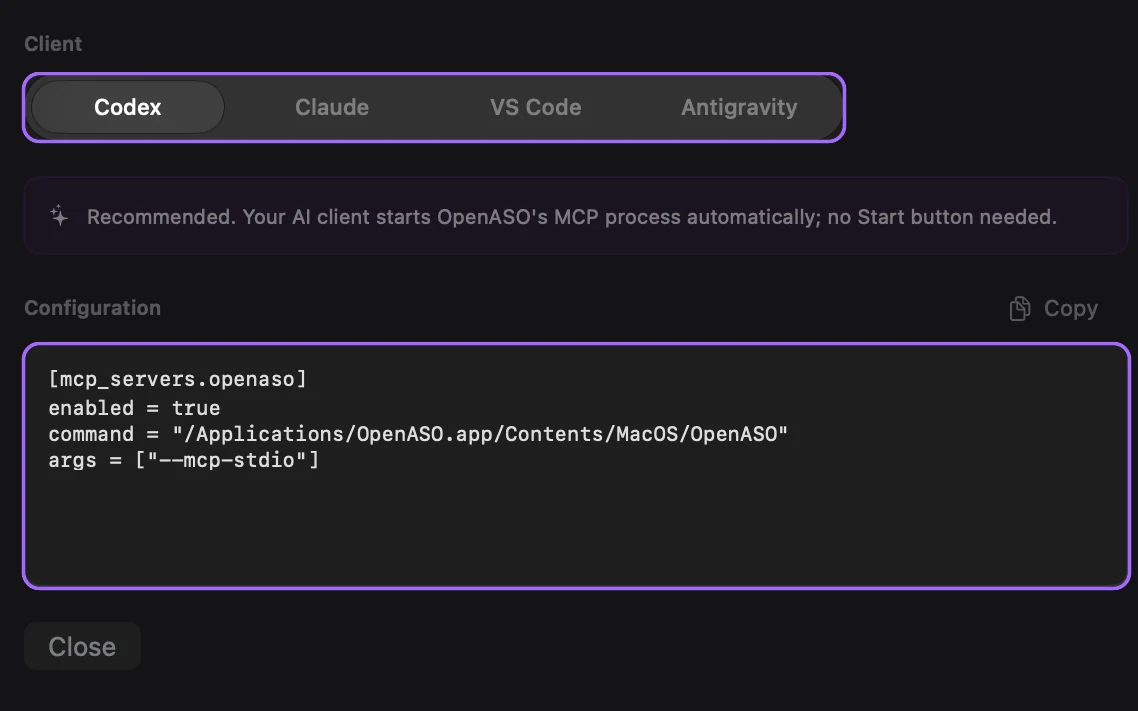
Both offer local MCP servers. Astro's docs describe its MCP server as being in beta. OpenASO can copy setup details for Claude, Codex, VS Code, and Antigravity.
OpenASO publishes this article and makes a competing ASO app. Spotted something out of date? Send a correction.